Data loss doesn’t usually come with a warning. It’s often something simple – a file gets deleted, a sync goes wrong, or ransomware hits – and suddenly you’re scrambling to recover critical information.
That’s exactly why the 3-2-1 backup rule continues to be one of the most trusted approaches in IT. It’s straightforward, practical, and designed to make sure your data is protected when it matters most.
What is the 3-2-1 Backup Rule?
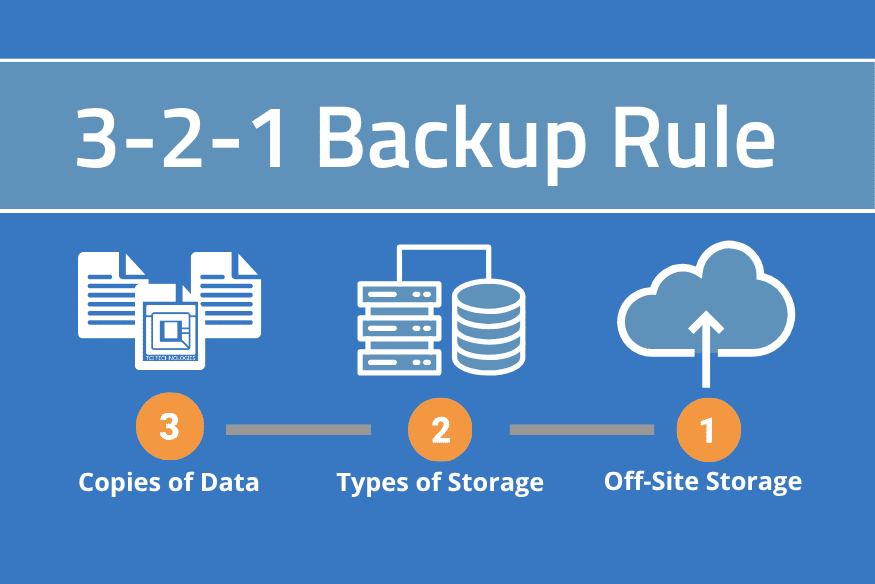
At a glance, the 3-2-1 backup rule is simple:
-
- Keep (3) copies of your data
- Use (2) different types of storage
- Store (1) copy offsite or isolated
Each part plays a role in protecting you from different risks, whether it’s human error, system failure, or a cyberattack.
1. Three Copies of Your Data
The first principle is redundancy. You should always have:
-
- Your primary data (what users actively work on)
- At least two backup copies
For example, your team might work in a platform like Microsoft 365 (SharePoint), while backups are handled by tools like Veeam or Acronis.
If one copy is lost, corrupted, or encrypted, the others remain available. Without multiple copies, recovery options are limited, or nonexistent.
2. Two Different Storage Types
Not all storage is created equal. Relying on a single system or environment increases risk.
A stronger approach is to diversify:
-
- Cloud storage (like Microsoft 365 or other cloud providers)
- Local storage (such as NAS devices or on-prem servers)
For instance, Veeam is often used for fast, local backups, while Acronis can store data in a separate cloud environment. This mix helps protect you from things like hardware failures, outages, or even vendor-specific issues.
3. One Offsite or Isolated Copy
This is your safety net when everything else goes wrong.
Some threats don’t stay contained:
-
- Ransomware can spread and encrypt connected backups
- Mistakes or deletions can sync across systems
- Physical disasters can impact entire locations
That’s why at least one backup should be offsite or protected from tampering. This could be a secure cloud backup with Acronis or an immutable backup setup using Veeam.
Having that clean, isolated copy can make all the difference in a worst-case scenario.
Why The 3-2-1 Backup Rule Still Matters in the Cloud Era
 It’s easy to assume that cloud platforms automatically take care of backups, but that’s not quite how it works.
Services like Microsoft 365 provide availability and basic retention, but they follow a shared responsibility model:
-
- They manage the platform
- You’re responsible for your data
That means accidental deletions, ransomware, and data corruption are still your responsibility to recover from.
A Practical Approach
In a modern environment, the 3-2-1 backup rule might look like this:
-
- Primary data → Cloud platform (e.g., SharePoint)
- Backup #1 → Local backup for fast recovery (e.g., Veeam)
- Backup #2 (offsite) → Secure cloud backup (e.g., Acronis)
This gives you:
-
- Fast recovery when you need it
- A reliable fallback if things go sideways
- Flexibility across different scenarios
Stay One Step Ahead of Data Loss
The 3-2-1 Backup Rule has stood the test of time because it addresses the core risks of data loss in a simple, effective way. Technology has evolved, but the need for redundancy, diversity, and isolation hasn’t changed.
At the end of the day, it comes down to this: don’t rely on a single copy, a single system, or a single location.
If your data matters, your backup strategy should too. Talk to our team today.